Async communication habits for distributed teams
Make messages useful to teammates in other time zones. Include the decision needed, context, deadline, owner and links in one message
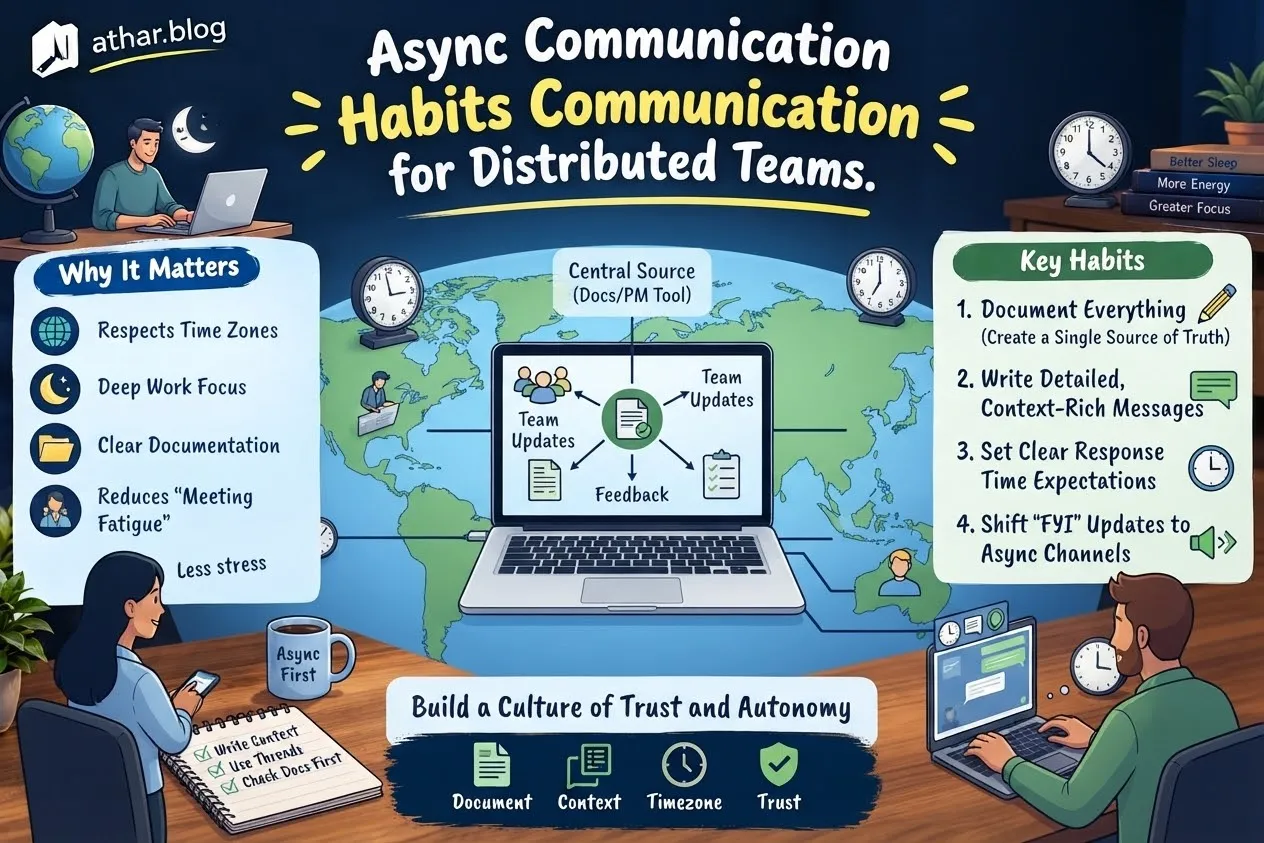
Effective asynchronous communication is a cornerstone for any successful distributed team. Rather than adopting a generic playbook, the most impactful improvements stem from a clear understanding of current challenges, available resources, and tangible metrics for success. The objective is not to replicate another organization's workflow, but to craft a bespoke strategy that aligns with your team's unique constraints and operational rhythm, particularly when collaborating across diverse time zones.
Defining Your Asynchronous Communication Objectives
Before implementing any changes, articulate the specific outcome you wish to achieve in a single, unambiguous sentence. This clarity helps differentiate measurable goals from broad aspirations. For instance, "reducing time spent in status meetings by 30%," "decreasing critical errors in project handoffs by 15%," or "establishing a consistent process for documenting architectural decisions" are distinct goals requiring different approaches.
It's equally important to identify what aspects of your current communication are already effective. Documenting these successful practices ensures they are not inadvertently discarded. Subsequently, meticulously record your existing communication processes, noting the time expenditure, associated costs, or points of friction. This baseline data is crucial for objectively evaluating the impact of any future modifications and determining whether your efforts have yielded genuine improvements. Without this initial assessment, measuring progress becomes subjective and unreliable.
Crafting a Practical Framework for Communication
Efficient asynchronous communication thrives on well-structured messages that provide all necessary context upfront. Every significant communication — whether an update, a proposal, or a decision — should systematically include:
- The specific decision or action required.
- Sufficient context to enable understanding without further inquiry.
- A clear deadline for input, feedback, or action.
- The designated owner responsible for the next steps.
- Relevant links to supporting documents, previous discussions, or related resources.
Crucially, all final decisions must be recorded in a centralized, easily accessible location, such as a project management tool, a shared wiki, or a dedicated documentation platform. When faced with multiple viable options, a structured comparison using consistent criteria is invaluable. Evaluate each option based on:
- Implementation cost (financial and resource investment).
- Effort required for setup and ongoing maintenance.
- Reliability and stability of the proposed solution.
- Reversibility if the chosen path proves ineffective.
- Impact on affected team members, considering their roles and workflows.
A concise, written comparison prevents costly missteps that arise from committing to a solution before fully understanding its trade-offs. Begin with the minimum viable change or tool. If it demonstrates utility, iterate and enhance it. If it doesn't meet expectations, you can pivot quickly without having wasted significant time or resources.
Practical Application: Streamlining Decision-Making
Consider a scenario where a product lead needs to decide on a new feature's user interface. Instead of a vague chat message like "Thoughts on the new UI?", a more effective asynchronous approach would be:
- Present Two Options: Clearly outline "Option A: Tabbed Interface" and "Option B: Accordion Interface."
- Provide Context & Rationale: Briefly explain the pros and cons of each, linking to mockups and user research findings.
- Offer a Recommendation: "I recommend Option A due to its better mobile responsiveness and alignment with our existing design system."
- Set an Objection Deadline: "Please provide any critical objections or alternative suggestions by end-of-day Friday, [Date]."
- Designate Owner: "I will finalize the decision based on feedback and communicate the outcome by Monday."
This structured approach respects team members' time zones, provides all necessary information, and creates a clear pathway to a decision. It replaces ambiguity with actionable requests.
Real-World Examples of Async Tools
Many tools facilitate effective asynchronous communication. Here are a few examples and their uses:
- Asana/Jira/ClickUp: For project management, task assignment, status updates, and decision logging.
- Confluence/Notion/Google Docs: For detailed documentation, meeting notes, knowledge bases, and collaborative policy drafting.
- Loom/Vidyard: For quick video explanations, screen recordings for bug reports, or personalized feedback that benefits from visual cues.
- Slack/Microsoft Teams (with intentional usage): For quick queries, sharing small updates, and focused discussions when used thoughtfully to avoid real-time expectation.
- Email: For formal announcements, critical information sharing, and communication with external stakeholders.
Establishing Clear Expectations for Asynchronous Interaction
Successful asynchronous work requires a cultural shift towards intentional communication. Implement these guidelines:
- Default to Documentation: For anything beyond a fleeting thought, assume it needs to be documented.
- Define Response Times: Establish realistic expectations, e.g., "Non-urgent messages will receive a response within 24 business hours."
- Encourage Detailed Posts: Train team members to provide context, purpose, and clear calls to action in every message.
- Batch Communications: Encourage team members to consolidate multiple small points into a single, comprehensive update or question rather than sending several individual messages.
- Use Dedicated Channels/Threads: Maintain focus by keeping discussions within relevant channels or threads, and clearly indicating when a decision needs to be made.
- "No Meeting" Days/Blocks: Designate specific periods for focused individual work, free from the expectation of immediate responses.
Recognizing Potential Pitfalls
An unmanaged asynchronous communication stream can become a source of hidden work, particularly if discussions lack clear ownership or purpose. Extended, meandering threads without a designated decision-maker or facilitator can lead to information overload and decision paralysis. Moreover, it's crucial to acknowledge that asynchronous communication is not universally applicable. Highly sensitive discussions, urgent crises requiring immediate collective input, or complex negotiations might still benefit from synchronous interaction.
Be critical of advice that omits discussion of implementation costs, specific contextual requirements, or inherent uncertainties. Every strategy has trade-offs. It is equally important to meticulously record what went wrong as what succeeded. A project that misses its targets, or a communication strategy that fails to deliver expected clarity, provides invaluable data. This information should be seen as an opportunity for refinement, not a reason to abandon the entire initiative. Furthermore, when dealing with topics involving financial implications, health and safety, legal compliance, or sensitive personal information, always verify local regulations and seek qualified professional advice when appropriate.
Your Next Practical Steps for Improvement
To initiate a tangible improvement, select one recurring meeting that frequently lacks clear outcomes or could be streamlined. Transform its agenda into a structured decision memo or update document. This memo should clearly state the purpose, provide necessary background, outline any decisions required, and specify who is responsible for follow-up actions.
Schedule a realistic review date – perhaps three to four weeks after implementing this change. At the review point, objectively compare the results with your initial baseline observations. Ask yourself:
- Has clarity genuinely improved for team members across different time zones?
- Did this change effectively solve the original problem or friction point you identified?
- What are the quantifiable benefits (e.g., time saved, reduced errors)?
Based on this assessment, decide whether to continue with the revised approach, implement further refinements, or discontinue it. Sustainable progress often emerges from iterative, modest adjustments, carefully evaluated, rather than from singular, dramatic overhauls. Maintain detailed notes throughout this process. Your own documented evidence of what works and what doesn't, tailored to your team's context, is far more valuable than any generic success story.
Related Articles

دليل إعلانات النوافذ المنبثقة (Popunder): كيف تحقق أعلى أرباح دون تدمير تجربة المستخدم في 2026
دليل استراتيجي لاستخدام إعلانات النوافذ المنبثقة (Popunder) في مدونتك لتحقيق أعلى عائد لكل ألف ظهور (CPM) دون إزعاج الزائر أو التأثير على معايير السيو.

فن كتابة الإعلانات والنصوص البيعية (Copywriting): كيف تضاعف نقرات وأرباح مقالاتك
تعلم أسرار فن كتابة الإعلانات (Copywriting) لزيادة نقرات روابط الأفلييت وأرباح مدونتك في 2026. معادلات نفسية مجربة لكتابة نصوص تحفز القارئ على الشراء.

العمل الحر من العالم العربي: دليل البداية خطوة بخطوة
دليل عملي للبدء في العمل الحر: اختيار المهارة، بناء معرض أعمال، التسعير، استلام المدفوعات وتجنب الاحتيال.