Content marketing funnel explained with real customer questions
Match information to the stage of a decision. Create awareness pages for discovering a problem, comparison pages for evaluating approaches and practical pages
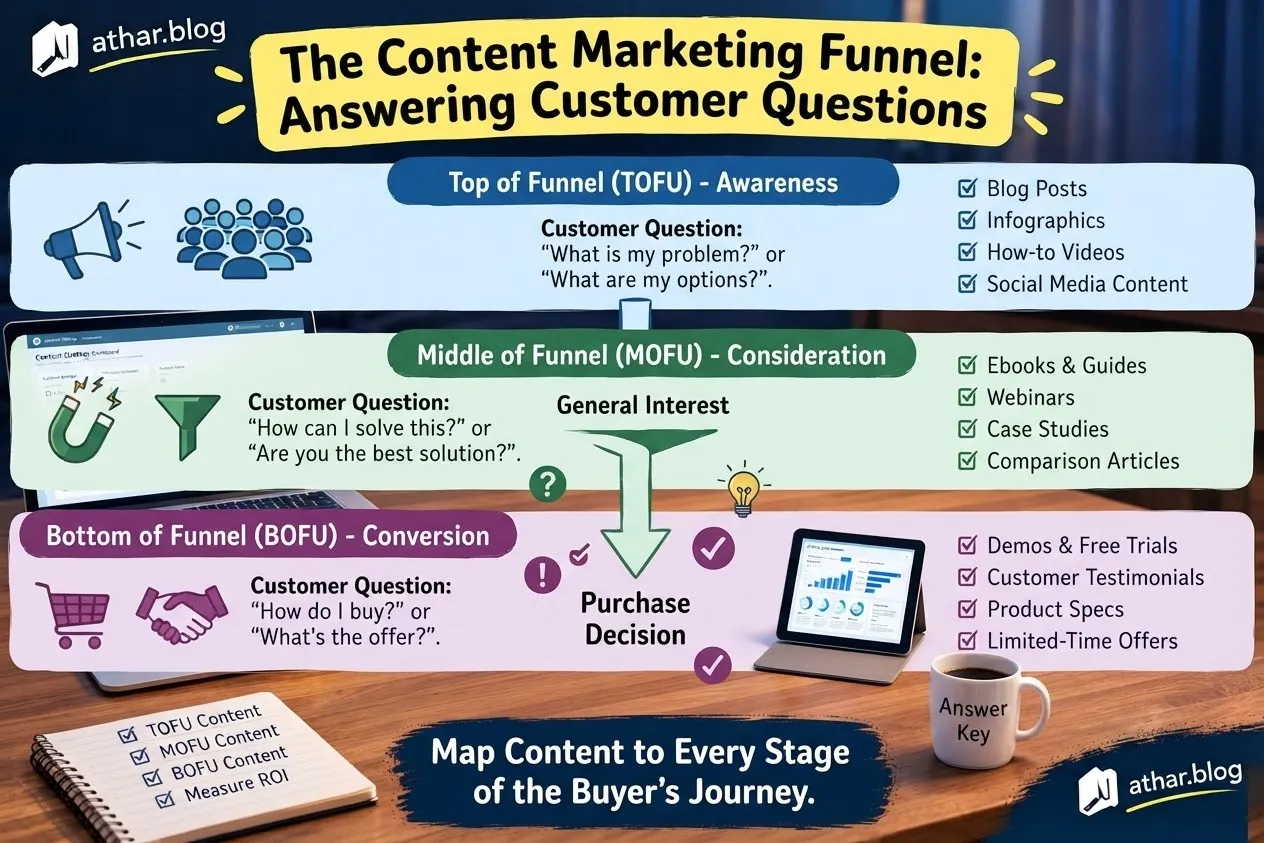
Content marketing is most effective when approached not as a collection of impressive terms, but as a strategic process guided by specific decisions. Understanding the content marketing funnel through the lens of real customer questions allows for a more accessible and impactful strategy. This process begins by clearly identifying what needs to change, assessing available resources, and establishing measurable criteria for success. The core principle is to align content with each stage of a customer's decision-making journey. The objective is not to replicate another organization's routine, but to make deliberate choices that are tailored to your unique constraints and opportunities.
Defining Your Strategic Objective
Before embarking on any content creation, it's crucial to articulate the desired outcome. Begin by stating the result you aim to achieve in a single, clear sentence. This outcome should be a measurable objective, distinct from a vague aspiration. For example, "reducing customer support inquiries by 15%" is a measurable outcome, whereas "improving customer satisfaction" is a broad aspiration. Consider various types of jobs your content might perform:
- Saving time: Helping customers quickly find information or complete a task.
- Avoiding errors: Providing clear instructions or warnings to prevent common mistakes.
- Answering specific customer questions: Addressing frequently asked questions proactively.
- Building a consistent habit: Encouraging repeat engagement or product usage.
Before implementing any changes, take stock of what is currently working well. Document these successful elements to avoid discarding them unnecessarily. Concurrently, meticulously record your current processes, noting the time, cost, or friction involved. This detailed baseline provides an objective point of comparison, enabling you to accurately assess the impact of future changes.
Structuring Your Content Funnel for Impact
A highly effective content marketing funnel is built upon a logical progression of information designed to guide customers through their journey. This typically involves three main types of pages, each serving a distinct purpose within the funnel:
- Awareness Pages: These pieces of content are designed for individuals just discovering a problem or need. They educate, inform, and help potential customers recognize their challenges without immediately pushing a product or service. Examples include blog posts addressing common pain points, informational guides, or industry trend analyses.
- Comparison Pages: Once a potential customer understands their problem, they begin exploring potential solutions. Comparison pages help them evaluate different approaches, products, or services. This content might include feature comparisons, pros and cons analyses, or detailed reviews that highlight key differentiators.
- Practical Pages: At the bottom of the funnel, practical pages provide the necessary information for taking action. These are designed for individuals ready to make a decision or implement a solution. This includes how-to guides, tutorials, case studies, product demonstrations, and pricing information.
When faced with multiple attractive options, it is essential to compare them using a consistent set of criteria. This might include cost implications, the effort required for setup or implementation, reliability, the reversibility of the decision, and the various stakeholders or people affected. A simple, written comparison document can often prevent the most costly mistakes – those arising from committing to a path before fully understanding its trade-offs. Always begin with the smallest viable version of your content initiative. If it proves effective, you can then incrementally improve and expand it. If it doesn't yield the desired results, you can pivot without having invested months of work into an ineffective strategy.
What This Can Look Like
Consider the journey of a small business owner seeking financial organization. A well-constructed content funnel could guide them through their problem:
- Awareness: A blog post titled "How to Organize Receipts for Small Businesses: 5 Simple Strategies" (for problem discovery).
- Comparison: An article comparing "Cloud-based Accounting Software vs. Spreadsheet Tracking: Which is Right for You?" (for evaluating approaches).
- Practical: A downloadable "Checklist for Preparing Your First Consultation with a Bookkeeper" (for taking action).
This example starts with a real constraint (receipt organization) and aims for an observable outcome (organized finances), rather than making an unrealistic promise of universal success. The scale and specific details should always be adapted to your unique situation. If a decision impacts others, actively solicit their input on what would genuinely make the change useful, rather than making assumptions.
Addressing Customer Questions Effectively
To create truly effective content for each stage of the funnel, it's vital to anticipate and directly address common customer questions. This approach ensures your content is always relevant and valuable.
Here's how to map common questions to funnel stages:
- Awareness Stage (Top of Funnel):
- "What is [problem/topic]?"
- "Why is [problem/topic] happening?"
- "What are the symptoms of [problem]?"
- "How does [industry trend] affect me?"
- Example: A SaaS company might create a blog post titled "What is API Security and Why Your Business Needs It."
- Consideration Stage (Middle of Funnel):
- "How can I solve [problem]?"
- "What are the best [solution types]?"
- "How does [Solution A] compare to [Solution B]?"
- "What are the pros and cons of [solution]?"
- Example: The SaaS company might follow up with an article comparing "API Gateway vs. WAF for Comprehensive Security."
- Decision Stage (Bottom of Funnel):
- "How much does [product/service] cost?"
- "How does [product/service] work?"
- "What are the features of [product/service]?"
- "Who uses [product/service]?" (Case studies, testimonials)
- "How do I get started with [product/service]?" (Demo, trial, sign-up guide)
- Example: Finally, the company could offer a "Request a Demo: See Our API Security Solution in Action" page or a detailed "Pricing Plans for API Security" breakdown.
By directly answering these questions, you build trust and position your brand as a helpful authority, guiding potential customers naturally towards your solution.
Critical Considerations and Pitfalls to Avoid
Not every piece of content should overtly function as a sales pitch. Overly promotional content can deter potential customers. Avoid creating superficial "best" lists that gloss over crucial trade-offs or lack genuine insight. Be particularly cautious of advice that omits discussion of associated costs, specific contextual factors, or inherent uncertainties.
It is equally important to document what went wrong as carefully as what succeeded. A missed target is not a failure but valuable information that can inform future decisions. If the topic of your content involves sensitive areas such as financial matters, health advice, legal obligations, or private information, always verify relevant local regulations and seek qualified professional guidance when necessary. Transparency and accuracy are paramount in these domains.
Implementing and Iterating: Your Next Steps
To refine your content marketing strategy, begin by auditing your existing content library. Identify at least one unanswered question at each stage of your customer decision funnel. This will highlight immediate content gaps.
Practical Steps for Improvement
- Content Audit:
- Review current blog posts, articles, and landing pages.
- Identify which funnel stage (awareness, consideration, decision) each piece addresses.
- Note content that is underperforming or outdated.
- Gap Analysis:
- Based on customer questions and funnel stages, pinpoint specific topics or questions that are not adequately covered.
- Prioritize new content creation based on perceived customer need and business impact.
- Content Creation Plan:
- Develop a realistic plan for creating new content for identified gaps.
- Assign responsibilities and set deadlines.
- Establish Review Metrics:
- For each new piece of content or significant update, define specific metrics to track its performance (e.g., organic traffic, time on page, conversion rate).
- Set a realistic review date for evaluating its impact.
At your designated review date, compare the results against your initial baseline. Ask yourself whether the changes genuinely solved the original problem you identified. Based on this assessment, decide whether to continue with the current strategy, revise it based on new insights, or discontinue it if it's not yielding the desired outcomes. Meaningful progress often stems from consistent, modest actions, carefully executed, rather than from singular, dramatic decisions. Maintain meticulous notes throughout this process. This collection of evidence, derived from your own experience, will be invaluable in informing your future choices, allowing you to move beyond relying solely on generic success stories.
Related articles:

العمل الحر من العالم العربي: دليل البداية خطوة بخطوة
دليل عملي للبدء في العمل الحر: اختيار المهارة، بناء معرض أعمال، التسعير، استلام المدفوعات وتجنب الاحتيال.

أفضل بدائل جوجل أدسنس للمواقع والمدونات العربية في 2026: شبكات إعلانية تقبل المواقع الجديدة
دليل أفضل شبكات بدائل جوجل أدسنس للمواقع والمدونات العربية في 2026. شبكات تقبل المواقع الجديدة بدون شروط تعجيزية وتدفع بانتظام عبر بايبال والعملات الرقمية.
Small Business Marketing Without a Big Budget
Proven low-cost strategies for local shops and freelancers to attract customers and build loyalty.