Freelance pricing: hourly, project and retainer models
Price for the work and risk involved, not only minutes at a keyboard. Estimate research, revisions, meetings, taxes, tools and unpaid sales time
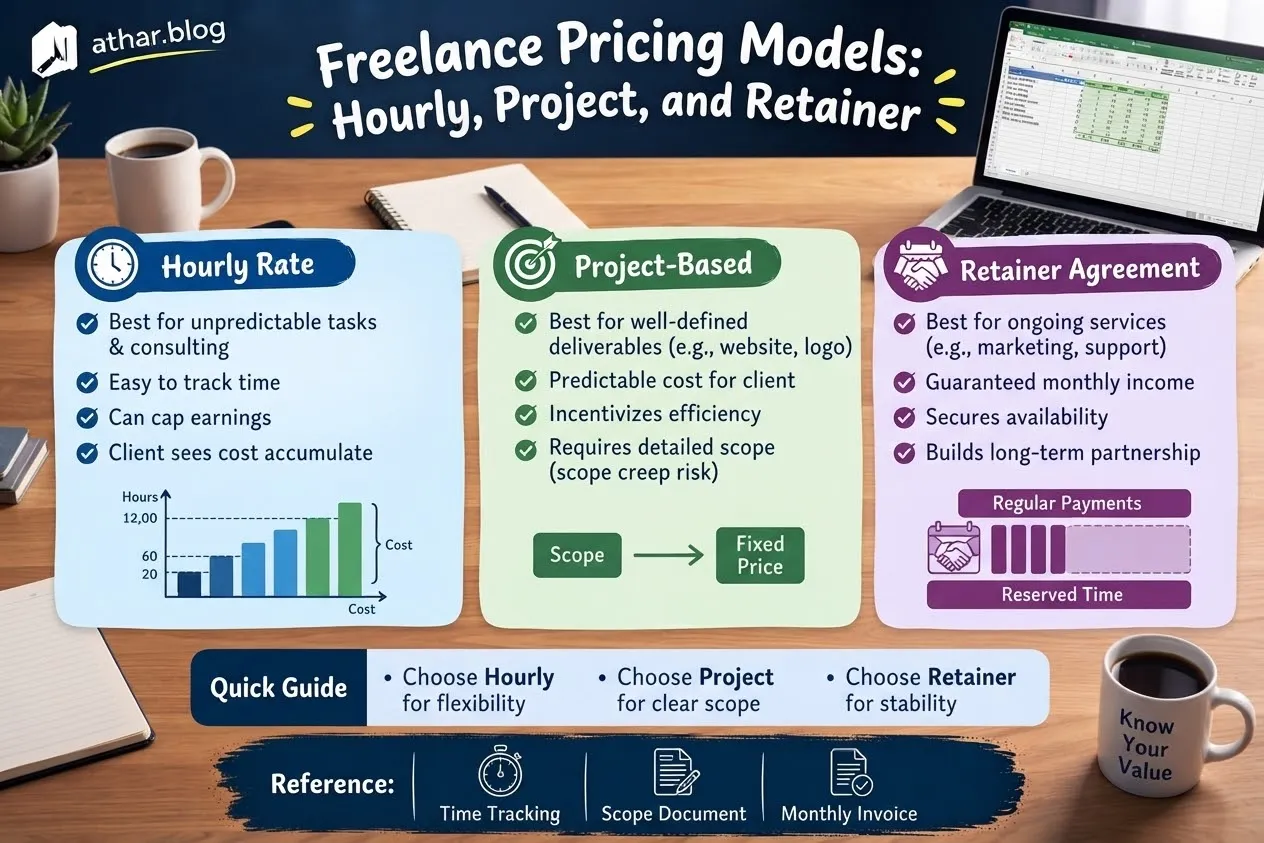
A useful guide for freelance professionals starts not with a collection of impressive terms, but with a specific, actionable decision. Approaching the topic of freelance pricing – whether hourly, project-based, or retainer models – becomes significantly more manageable when you precisely identify what changes you intend to implement, what resources are at your disposal to facilitate these changes, and how you will quantitatively or qualitatively determine if the new approach has been successful. The fundamental principle is to price for the value of the work delivered and the inherent risks assumed, not merely for the minutes spent at a keyboard. The objective here is not to replicate someone else’s pricing strategy or operational routine, but rather to make a thoughtful, informed choice that is meticulously tailored to your unique circumstances and constraints.
Starting with the Core Question
Before delving into the specifics of pricing models, it's crucial to define your desired outcome with clarity and precision. Articulate the result you seek in a single, unambiguous sentence. Differentiate between a measurable, tangible outcome and a vague aspiration. For instance, "reducing client communication overhead by 20%" is a measurable outcome, whereas "saving time" is a vague aspiration. Specific objectives might include:
- Saving time: For example, automating invoicing to save 3 hours per month.
- Avoiding errors: Implementing a pre-submission checklist to reduce revision requests by 15%.
- Improving customer satisfaction: Responding to customer inquiries within 4 hours, leading to higher client retention.
- Building a consistent habit: Dedicating 30 minutes daily to business development activities.
Simultaneously, identify elements of your current workflow or pricing strategy that are already effective or efficient. This prevents inadvertently discarding valuable practices. Prior to initiating any changes, meticulously document your existing process, noting the time investment, associated costs, and any friction points involved. This detailed baseline provides a fair and objective standard against which to compare the results of your new approach.
Building a Practical Pricing Approach
Developing a robust pricing strategy requires comprehensive foresight. It's essential to meticulously estimate all components that contribute to your operational costs and time investment. This includes:
- Research time: Time spent understanding client needs, industry trends, or specific project requirements.
- Revision cycles: Anticipated time for client feedback integration and iterative improvements.
- Meetings: Time allocated for client consultations, status updates, and project debriefs.
- Taxes and overheads: Accounting for income taxes, business insurance, software subscriptions, office supplies, and other operational expenses.
- Tools and software: Costs associated with specialized software, licenses, or hardware.
- Unpaid sales time: Hours spent on proposals, client pitches, and marketing efforts that don't directly convert into billable work.
Before presenting any quote, clearly define the project deliverables and establish explicit limits on revisions. When faced with multiple attractive pricing options – such as hourly, project, or retainer – evaluate each using a consistent set of criteria.
Practical Evaluation Criteria:
- Cost: What are the direct financial implications for you and the client?
- Effort to set up: How much time and resources are required to implement and manage this model?
- Reliability: How predictable is the income stream or workload under this model?
- Reversibility: How easy is it to pivot to a different model if this one proves ineffective?
- People affected: Who on your team or the client's team will be impacted, and how?
A simple, written comparison using these criteria can proactively prevent costly mistakes that arise from committing to a strategy before fully comprehending its trade-offs. Begin with the smallest viable version of your chosen approach. If it demonstrates tangible benefits, progressively refine and expand it. If it doesn't meet expectations, you can adjust your course without having invested months of effort into an unfruitful direction.
Real-world Application Examples
Consider a web designer who offers branding services. They might implement a fixed project fee for a comprehensive brand identity kit, which includes logo design, typography guidelines, and a style guide. This package has clearly defined deliverables and a specific timeline. However, for ongoing social media content creation and website maintenance, they could employ a monthly retainer model, providing a set number of hours or deliverables per month. This hybrid approach caters to both one-off, project-based needs and continuous service requirements, offering predictable income for the designer and consistent support for the client. This example clearly illustrates starting with a practical constraint and an observable outcome, rather than an unrealistic promise of universal success. Tailor the scale and specifics to your individual situation. If a decision impacts another person, engage them in a dialogue about what would genuinely make the change beneficial for them, rather than making assumptions about their needs.
Navigating Potential Pitfalls
A common pitfall is underpricing services due to the perception that the initial draft or delivery was quick. This overlooks years of accumulated expertise, specialized knowledge, and the administrative overhead required to run a business. Offering unlimited revisions can quickly render even a generously calculated quote unprofitable, transforming a profitable engagement into a substantial loss.
Be particularly cautious of advice that omits critical details such as costs, specific context, or inherent uncertainties. Maintain meticulous records of both successes and setbacks. A missed target or an unsuccessful implementation should be viewed as valuable data points, not as grounds to abandon an entire strategic plan. This information is crucial for future decision-making.
For matters involving financial transactions, health-related services, legal obligations, or sensitive data, always verify relevant regulations and compliance requirements within your local jurisdiction. Seek qualified professional guidance from accountants, lawyers, or industry specialists when necessary to ensure adherence to legal and ethical standards.
Your Immediate Next Steps
To effectively implement an informed pricing strategy, follow these steps:
- Calculate your Minimum Sustainable Rate (MSR):
- List all your monthly personal expenses (rent, food, insurance, savings, etc.).
- List all your monthly business expenses (software, internet, taxes, marketing, etc.).
- Add these two totals to get your total monthly financial need.
- Estimate your total billable hours per month (after deducting administrative time, marketing, etc.).
- Divide your total monthly financial need by your billable hours to get your MSR. This is the absolute minimum you need to charge hourly to sustain your life and business.
- Develop three distinct service packages:
- Basic: Offers essential deliverables with limited scope.
- Standard: Includes additional features, more revisions, or slightly broader scope.
- Premium: Provides comprehensive solutions, priority support, and possibly a wider range of services.
- For each package, clearly articulate the scope of work, defined deliverables, number of revisions included, timeline, and explicit payment terms (e.g., 50% upfront, 50% upon completion).
- Set a realistic review date: Schedule a specific date in your calendar (e.g., 3 months from now) to evaluate the effectiveness of your new pricing strategy.
- At the review date:
- Compare the financial and operational results against your initial baseline.
- Assess whether the changes successfully addressed your original problem statement (e.g., "Did automating invoicing actually save 3 hours per month?").
- Decide whether to continue with the current strategy, revise specific elements, or revert to a previous approach.
Sustainable progress often stems from consistent, modest actions, meticulously repeated, rather than from singular, dramatic decisions. Maintain detailed notes on your observations, challenges, and successes. This personal evidence will empower you to make future choices that are genuinely informed by your own experience, rather than relying solely on generic success narratives.
--- Related Articles:

العمل الحر من العالم العربي: دليل البداية خطوة بخطوة
دليل عملي للبدء في العمل الحر: اختيار المهارة، بناء معرض أعمال، التسعير، استلام المدفوعات وتجنب الاحتيال.

أفضل بدائل جوجل أدسنس للمواقع والمدونات العربية في 2026: شبكات إعلانية تقبل المواقع الجديدة
دليل أفضل شبكات بدائل جوجل أدسنس للمواقع والمدونات العربية في 2026. شبكات تقبل المواقع الجديدة بدون شروط تعجيزية وتدفع بانتظام عبر بايبال والعملات الرقمية.
Small Business Marketing Without a Big Budget
Proven low-cost strategies for local shops and freelancers to attract customers and build loyalty.