How to plan a productive week without overloading it
Plan from available hours and real constraints, not an ideal calendar. Identify two or three outcomes, estimate focused time and leave room for routine requests
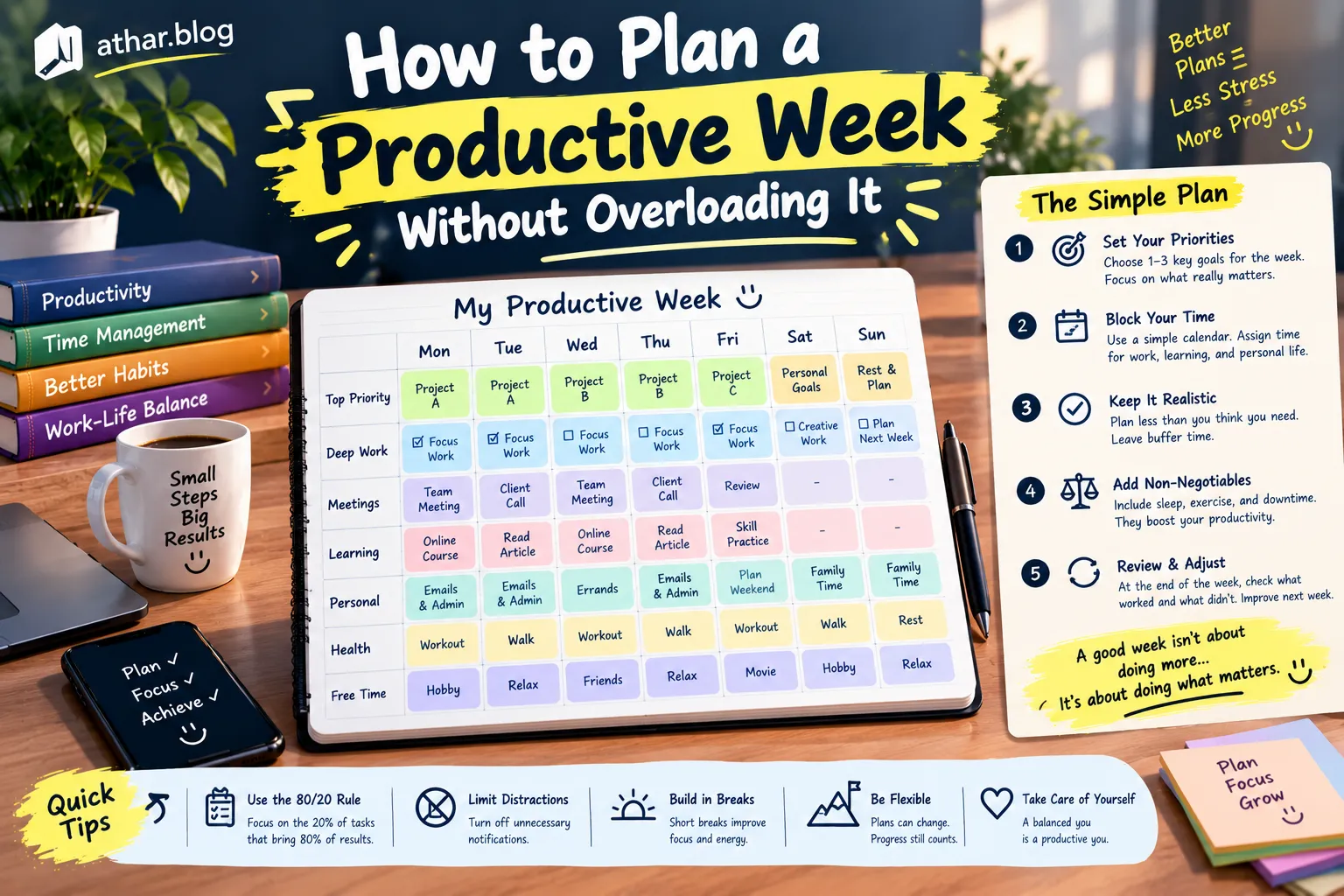
A productive week is built upon deliberate decisions, not just a collection of impressive ideas. The art of planning a productive week without overwhelming your schedule becomes much more accessible when you first pinpoint what truly requires adjustment, accurately assess the resources at your disposal, and define how you will measure success. Effective planning starts with an honest appraisal of your available hours and real-world constraints, rather than trying to fit your life into an ideal, pre-made calendar. The core objective here is not to emulate someone else's routine or adopt a trendy productivity hack. Instead, it is about crafting a thoughtful, personalized approach that aligns perfectly with your unique circumstances and limitations.
Defining Your Desired Outcomes
Begin your planning journey by articulating the specific result you wish to achieve in a single, clear sentence. This clarity helps differentiate a measurable outcome from a vague aspiration. For example, "saving ten hours per week on administrative tasks" is a concrete outcome, distinct from "having more free time." Similarly, "reducing customer support response time to under four hours," "eliminating three common data entry errors," or "consistently exercising for thirty minutes three times a week" are distinct, measurable jobs.
Before contemplating any changes, take stock of what is currently effective in your routine. Identifying these successes prevents you from discarding valuable processes without good reason. Document your current workflow, noting the time, cost, or friction involved. This detailed observation provides a fair and objective baseline against which you can later compare your new approach, allowing for an accurate assessment of its impact.
Constructing a Sustainable Strategy
When developing your weekly plan, focus on identifying no more than two or three key outcomes that will drive your efforts. Estimate the amount of focused time each task will genuinely require and, critically, allocate ample buffer space for routine requests, unexpected interruptions, and essential self-care. Large projects should be broken down into smaller, manageable steps—ideally, each step should be completable within a single focused work session. This approach prevents overwhelming feelings and allows for consistent progress.
When faced with multiple attractive options for tackling a task or project, compare them systematically using consistent criteria. Consider:
- Cost: Not just financial, but also time and emotional investment.
- Effort to set up: How much initial work is required to implement the new approach?
- Reliability: How consistently can this method deliver the desired outcome?
- Reversibility: Can you easily revert if the new approach proves ineffective?
- People affected: Who else will be impacted by this change, and how?
A simple written comparison of these factors often prevents the most costly mistake: committing significant resources before fully understanding the trade-offs involved. Always aim to start with the smallest useful version of any new process or project. If this minimal version proves beneficial, you can then incrementally improve and expand it. If it doesn't yield the desired results, you can pivot or discontinue it without having invested months of effort unnecessarily.
Illustrative Scenarios
Consider a consultant who frequently juggles client calls. Instead of letting calls dictate their entire week, they might proactively block out two ninety-minute periods each week specifically for focused work on a new proposal. They might then reserve an entire Friday afternoon for reviewing pending revisions and processing invoices. This example clearly demonstrates planning around a real constraint (client calls) with an observable outcome (proposal progress, timely invoicing).
The key is to adapt the scale and specific details to your unique professional and personal context. If your plan impacts another person, engage them in the decision-making process. Ask them what would make the change genuinely useful and beneficial from their perspective, rather than making assumptions. This collaborative approach often uncovers unforeseen challenges or opportunities.
Planning for Contingencies
- Buffer Time: Always include 15-30% buffer time in your schedule for unexpected events.
- "No-Meeting" Blocks: Designate specific times when you won't accept meetings, allowing for deep work.
- Daily Review: Spend 10 minutes at the start or end of each day to adjust your plan based on actual progress.
Tools for Practical Planning
- Digital Calendar (e.g., Google Calendar, Outlook Calendar): Essential for blocking out time and setting reminders.
- Task Manager (e.g., Todoist, Asana, Trello): Breaks down projects into actionable tasks and tracks progress.
- Note-Taking App (e.g., Notion, Evernote, simple text editor): For capturing insights, documenting processes, and performing comparisons.
- Journal/Planner: A physical space for reflection and comparing planned vs. actual outcomes.
Critical Considerations
A list comprising twenty "top priorities" is, in effect, a list with no priorities at all. Overfilling every hour of your schedule leaves absolutely no capacity for unforeseen delays, urgent requests, or essential recovery time. Be particularly cautious of advice that overlooks the associated costs, ignores the unique context of your situation, or downplays inherent uncertainties. It's crucial to document what went wrong just as meticulously as you record what worked well. A missed target or an unfulfilled task should be viewed as valuable information for future adjustments, not a reason to abandon your entire strategic framework.
Moreover, if your planning touches upon critical areas such as financial management, health decisions, legal obligations, or sensitive personal information, always verify relevant rules and regulations within your local jurisdiction. Do not hesitate to seek qualified professional guidance when the situation warrants it.
Your Iterative Next Steps
At the conclusion of each week, dedicate time to objectively compare your planned outcomes with what was actually accomplished. Without falling into the trap of self-blame, use this data to refine your estimates for the following week. Set a realistic date for a more comprehensive review – perhaps monthly or quarterly. At this point, refer back to your initial baseline, evaluate whether your chosen approach effectively solved the original problem, and then make an informed decision: should you continue with this strategy, revise certain elements, or discontinue it altogether?
True progress often stems from consistent, modest actions repeated with careful attention, rather than from a single, dramatic, one-off decision. Maintain clear and concise notes throughout this process. These records will provide you with a personal evidence base, ensuring that your subsequent choices are informed by your own lived experience and data, rather than merely relying on generic success stories that may not apply to your unique circumstances.
Related Articles:

العمل الحر من العالم العربي: دليل البداية خطوة بخطوة
دليل عملي للبدء في العمل الحر: اختيار المهارة، بناء معرض أعمال، التسعير، استلام المدفوعات وتجنب الاحتيال.

أفضل بدائل جوجل أدسنس للمواقع والمدونات العربية في 2026: شبكات إعلانية تقبل المواقع الجديدة
دليل أفضل شبكات بدائل جوجل أدسنس للمواقع والمدونات العربية في 2026. شبكات تقبل المواقع الجديدة بدون شروط تعجيزية وتدفع بانتظام عبر بايبال والعملات الرقمية.
Small Business Marketing Without a Big Budget
Proven low-cost strategies for local shops and freelancers to attract customers and build loyalty.