Habit Stacking: A Science-Based Way to Build Habits That Last
How attaching a new behaviour to an existing routine makes habits stick, with examples, a setup plan and fixes for when you miss a day.
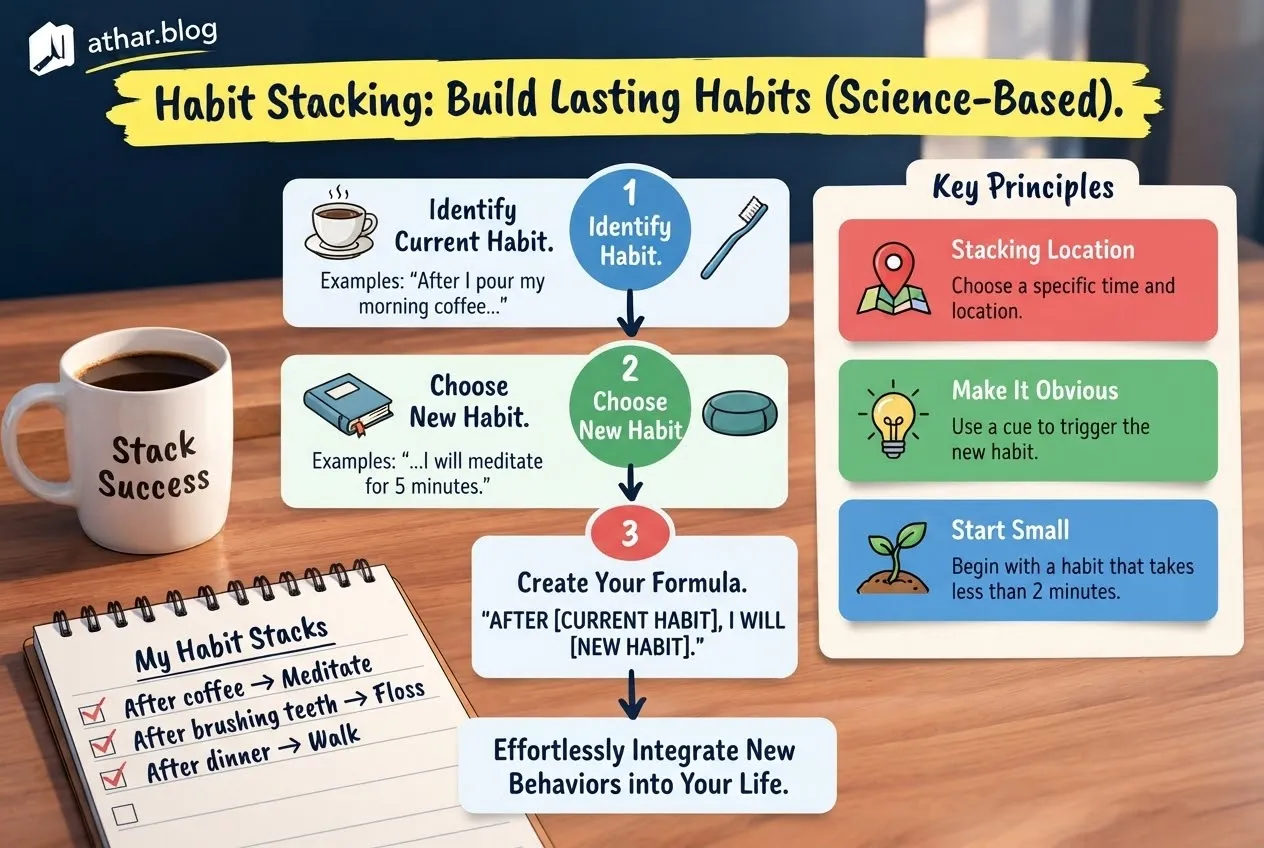
Habit stacking is a practical methodology for integrating new behaviors into daily life by linking them to established routines. This strategy leverages the power of existing habits as triggers, transforming the often-unpredictable process of habit formation into a more reliable and sustainable endeavor. By meticulously designing these linkages, individuals can systematically build a repertoire of desired actions without relying solely on fluctuating motivation.
Beyond Fleeting Motivation: The Core Principle of Automaticity
Many attempts at self-improvement falter because they hinge on motivation, an emotional state that, by its very nature, ebbs and flows. When motivation is high, initiating new behaviors feels effortless. However, maintaining consistency when enthusiasm wanes becomes the true challenge. Habit stacking sidesteps this pitfall by focusing on automaticity. A behavior becomes a habit not when you decide to do it, but when a familiar cue triggers it without conscious deliberation.
Consider the simple act of brushing your teeth. You likely don't debate whether to brush your teeth each morning; the sequence of waking up, walking to the bathroom, and seeing your toothbrush automatically initiates the action. Habit stacking taps into this ingrained response mechanism. It posits that if you consistently pair a desired new action with an existing, stable routine, the cue of the old routine will eventually become the cue for the new action, effectively automating the new behavior. This reduces the cognitive load and decision fatigue associated with starting something new, making it significantly easier to sustain over time.
Crafting Your Habit Stack: The Simple Formula
The foundational principle of habit stacking can be encapsulated in a straightforward formula, making it easy to apply to any new behavior you wish to cultivate. By structuring your intention in this specific way, you clarify the trigger and the action, reinforcing the psychological link.
The Stacking Formula
The core formula is: "After I [current habit], I will [new habit]."
This structure explicitly defines the anchor (your current, reliable habit) and the rider (your desired new habit). For example, instead of vaguely deciding to "start journaling," you would reframe it as: "After I pour my morning coffee, I will write three lines in my journal." In this instance, the aroma and warmth of your coffee become the immediate, tangible signal to pick up your journal. The reliability of your existing coffee ritual lends its strength and consistency to the nascent journaling practice.
Practical Application
To implement this, think about your daily routines. What actions do you perform without fail every day? These are your potential anchors. Then, identify a new small action you want to cultivate. For instance:
- Desired Action: Drink more water.
- Stack: After I finish my morning coffee, I will refill my water glass and drink it.
- Desired Action: Meditate for a few minutes.
- Stack: After I brush my teeth at night, I will sit for two minutes of silent meditation.
- Desired Action: Learn a new language.
- Stack: After I open my lunchbox, I will review five flashcards for [language].
The power lies in the specificity and the immediate succession of the two actions. The existing routine reminds you, and the new habit "borrows" its automaticity and reliability.
Selecting Robust Anchors for Your Stacks
The success of habit stacking hinges on the stability of your chosen anchor habits. Not all existing routines are created equal when it comes to serving as reliable triggers. The most effective anchors share specific characteristics that ensure their consistent presence in your daily life.
Characteristics of Effective Anchors
- Regularity: The best anchors are those that occur at the same time and in the same place every single day, or nearly every day. Think of ubiquitous daily actions.
- Consistency: They should be habits you rarely, if ever, skip. Their predictability is paramount.
- Specificity: The anchor should be a clearly defined action, not a vague state.
Consider examples like brushing your teeth, starting your laptop at work, finishing your lunch, or locking your front door. These are concrete, routine actions that typically don't vary much from day to day. Conversely, avoid using anchors that are dependent on fluctuating internal states or infrequent external events, such as "when I feel stressed," "when I have free time," or "when the phone rings." Such variable cues introduce inconsistency, undermining the very purpose of stacking. Choosing strong, stable anchors provides a firm foundation for your new habits to take root.
The Art of Starting Small: The Two-Minute Rule
One of the most common pitfalls in habit formation is trying to do too much too soon. Enthusiasm often leads to overcommitment, which quickly results in burnout and abandonment. Habit stacking emphasizes the "two-minute rule" for initial integration.
The Two-Minute Rule
Make the new habit take less than two minutes to perform, especially in the beginning. The goal during the initial weeks is not to achieve peak performance or significant results from the new habit itself. Instead, the primary objective is to repeatedly link the cue (your anchor habit) with the new action until the connection feels natural and automatic.
For instance, if your goal is to exercise more, your stack shouldn't be "After I fill my water bottle, I will do a 30-minute workout." Instead, it should be "After I fill my water bottle, I will do one push-up." Similarly, if you aim to read more, begin with "After I sit down to eat lunch, I will read one sentence from a book," rather than a whole chapter. The initial smallness dramatically lowers the barrier to entry, making it virtually impossible to skip. Once the cue-action link is firmly established and the new behavior feels like an automatic part of your routine, you can gradually increase the intensity or duration of the habit. This incremental growth ensures sustainability, as the habit grows organically from a solid, ingrained foundation.
Diverse Applications: Examples Across Life Domains
The versatility of habit stacking allows it to be applied across virtually any area of personal development. By identifying key routines in different aspects of your life, you can strategically introduce new behaviors that align with your goals.
Practical Habit Stacking Examples
- Health and Wellness:
- Hydration/Movement: "After I fill my water bottle, I will do ten squats." This couples a routine rehydration action with a quick burst of physical activity.
- Mindfulness: "After I finish my morning coffee, I will take three deep breaths."
- Learning and Development:
- Language/Knowledge Acquisition: "After I sit on the train for my commute, I will review five vocabulary cards." The commute becomes a dedicated learning slot.
- Skill Practice: "After I open my laptop for work, I will spend five minutes practicing [new software feature]."
- Financial Management:
- Saving: "After I get paid each month, I will automatically move a fixed amount to my savings account." This makes saving an immediate post-paycheck action.
- Budgeting: "After I review my bank statement, I will categorize one new expense."
- Relationships and Social Connections:
- Nurturing Bonds: "After dinner, I will send one thoughtful message to a friend or relative." This ensures consistent social outreach.
- Appreciation: "After I put away the dishes, I will tell my partner one thing I appreciate about them."
- Productivity and Organization:
- Task Planning: "After I check my email in the morning, I will write down the three most important tasks for the day."
- Decluttering: "After I finish cooking, I will put away one item that is out of place in the kitchen."
These examples illustrate how seemingly minor adjustments to your routine can lead to significant cumulative progress over time, simply by leveraging existing cues.
Monitoring Progress and Adapting Your Stacks
While the essence of habit stacking lies in automaticity, a gentle approach to tracking can provide valuable feedback and motivation. However, the tracking mechanism itself should not become another burden or a source of pressure.
Thoughtful Tracking Strategies
A simple calendar tick or a small 'X' on a physical planner is often sufficient. The act of seeing a chain of completed days can be subtly motivating, reinforcing your commitment. The key here is to view this tracking chain as a supportive tool, rather than a rigid test. Its purpose is to visualize consistency, not to induce guilt over an occasional miss.
It's also crucial to acknowledge that perfection is not the goal. The "never miss twice" rule is a powerful principle here. Missing once has a negligible effect on the overall habit formation process. However, missing repeatedly can quickly lead to the rebuilding of old, undesirable patterns. If you find yourself consistently failing to perform a new stacked habit, it's a strong indicator that either your chosen anchor is not stable enough, or the new action is still too large. In such cases, calmly reassess. Could you pick a more stable, inescapable cue? Or, more commonly, can you shrink the new action even further, making it even less demanding to initiate? Adaptability and self-compassion are vital components of successful habit formation.
Building Resilient Chains: Stacking with Care
While the concept of habit stacking encourages the integration of multiple desired behaviors, it's imperative to approach the creation of these chains strategically and patiently. Attempting to implement too many new habits concurrently can quickly lead to overwhelm and the collapse of the entire system.
Principles for Effective Chain Building
The most effective approach is to add one new habit at a time. This allows your brain to fully automate the link between the anchor and the new action. The duration required for this automation varies for individuals, but it often takes several weeks of consistent practice before a new behavior truly feels second nature. Only once a new habit has become firmly established and requires minimal conscious effort should you consider adding the next. Trying to string together long chains of multiple new habits before each link is robust can easily lead to the failure of the entire sequence. Patience and consistency in integrating one habit at a time will yield far more sustainable and successful results than an aggressive, multi-habit approach.
The Enduring Power of Micro-Actions
Ultimately, habit stacking distills down to a few critical principles that, when consistently applied, can transform your daily routines and propel you toward your goals without relying on heroic willpower. By tying small, manageable actions to routines you already perform without fail, you imbue these new behaviors with the automaticity of your existing schedule. Prioritizing consistent execution over intense, sporadic effort is paramount; the aim is daily adherence, not occasional perfection. Finally, allowing habits to grow organically once they are firmly established ensures their long-term sustainability. This methodical, science-based approach offers a practical roadmap for building lasting habits, one carefully stacked action at a time.
Related articles:

How to Write SEO-Friendly Blog Posts That Get Traffic
A practical, honest guide to SEO blog writing, with realistic options, safety checks, common mistakes, and a clear starting plan.

How to Start a Blog and Make Money in 2026
A practical, honest guide to start a blog and make money, with realistic options, safety checks, common mistakes, and a clear starting plan.

SEO in 2026: A Beginner's Guide to Ranking on Google
A practical, honest guide to SEO 2026, with realistic options, safety checks, common mistakes, and a clear starting plan.