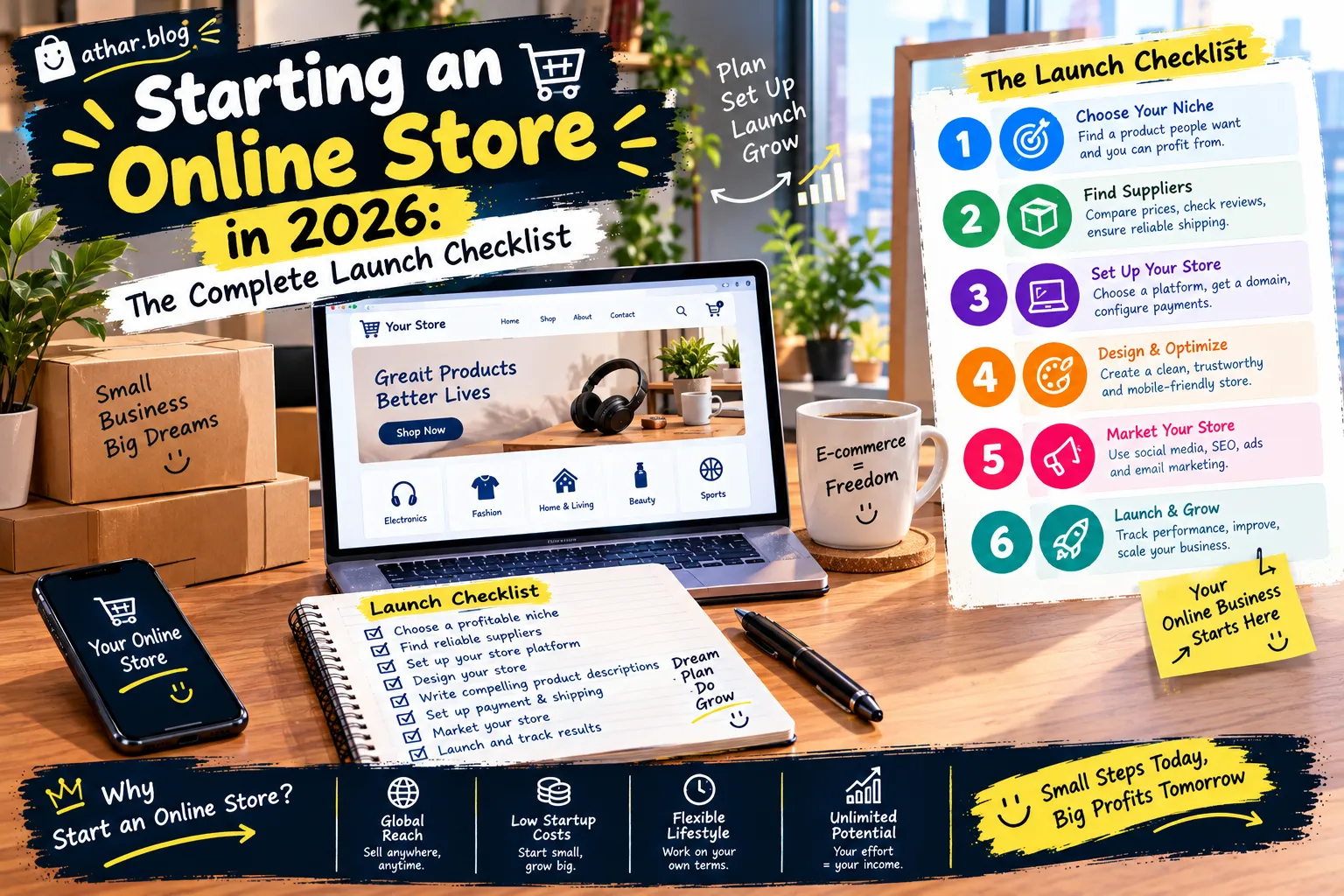
Starting an Online Store in 2026: The Complete Launch Checklist
Everything to decide before opening an online store: product choice, platform, payments, shipping, legal pages and your first marketing plan.
Thorough Product Validation: Building on Demand, Not Assumptions
Before dedicating significant resources to developing an online store, the foundational step involves rigorously validating your product idea. This critical phase ensures you're addressing a genuine market need and that your offering can generate sustainable profits. Launching a store without this groundwork risks wasted investment and effort.
To validate your product effectively, consider these key steps:
- Market Research and Trend Analysis:
- Search Trends: Utilize tools like Google Trends or SEMrush to gauge interest in specific keywords related to your product. Look for increasing search volume, indicating growing demand. For example, if you plan to sell eco-friendly kitchenware, analyze trends for "sustainable cutlery" or "bamboo kitchen tools."
- Competitor Analysis: Identify existing businesses selling similar products. Examine their product lines, pricing strategies, and, crucially, customer reviews. Pay close attention to common complaints or unmet needs expressed by their customers. These represent opportunities for you to differentiate your product or service. Perhaps competitors offer limited color options, slow shipping, or poor customer support – these are gaps you can fill.
- Social Listening: Monitor discussions on social media platforms, forums (like Reddit), and specialized communities where your target audience congregates. What problems are they discussing? What solutions are they seeking?
- Financial Feasibility and Profit Margins:
- Cost Analysis: Meticulously calculate all costs associated with your product. This includes raw materials, manufacturing (if applicable), packaging, and inbound shipping.
- Variable Expenses: Factor in per-unit expenses such as shipping to the customer, payment gateway fees (typically 1.5-3% + fixed fee), potential return processing costs, and a realistic budget for advertising (e.g., 10-20% of sale price).
- Minimum Viable Price (MVP): Determine the lowest price at which you can sell your product while still covering all costs and achieving a reasonable profit. A product with a razor-thin margin, especially after accounting for paid marketing, faces an uphill battle for profitability and long-term survival. Aim for a gross profit margin of at least 30-50% for physical goods to comfortably absorb marketing and operational costs.
Testing the Waters with Minimum Viable Products
Consider creating a minimum viable product (MVP) or conducting pre-sales campaigns on platforms like Kickstarter or Indiegogo. This allows you to collect orders and validate interest before committing to large-scale production or inventory. For digital products, a simple landing page collecting email addresses for early access can serve a similar purpose.
Strategic Business Model Selection
Your chosen business model dictates your operational workflow, capital requirements, and customer experience. Each model has distinct advantages and disadvantages:
- Holding Your Own Stock (Inventory-Based):
- Pros: Complete control over product quality, branding, packaging, and shipping speed. Allows for efficient bundling and custom order fulfillment.
- Cons: Requires significant upfront capital for inventory, warehouse space (or home storage), and managing stock levels. Risk of unsold inventory.
- Example: A boutique clothing store curating unique fashion pieces.
- Print-on-Demand (POD):
- Pros: Zero inventory costs, minimal upfront investment, wide range of customizable products (t-shirts, mugs, posters).
- Cons: Lower profit margins per item, less control over product quality and packaging, typically slower shipping times.
- Example: Selling custom-designed graphic tees or personalized phone cases.
- Dropshipping:
- Pros: No inventory management, low startup costs, wide product selection, flexibility to test new products rapidly.
- Cons: Dependence on third-party suppliers for product quality, inventory, and shipping; often longer delivery times; fierce competition.
- Example: Selling niche electronic gadgets sourced directly from an overseas manufacturer.
- Selling Digital Products:
- Pros: No physical inventory, high-profit margins (after initial creation), instant delivery, global reach.
- Cons: Requires expertise in content creation, potential for piracy, market saturation for some niches.
- Example: E-books, online courses, software licenses, digital art, or stock photography.
Hybrid Models and Scalability
Many successful online businesses employ hybrid models. For instance, you might start with dropshipping to validate demand, then transition to holding inventory for your best-selling items to improve profit margins and control. Or, you could offer both physical products (held in stock) and related digital guides (e-books) to diversify revenue.
Platform Selection: Your Digital Storefront
Choosing the right e-commerce platform is crucial for your store's functionality, scalability, and ease of management.
- Hosted Store Builders:
- Pros: Easiest and fastest to launch, comprehensive technical support, built-in security, hosting, and regular updates. Ideal for beginners.
- Cons: Monthly fees, less customization flexibility than self-hosted solutions, can be more expensive as you scale.
- Examples: Shopify, Squarespace, BigCommerce.
- Marketplaces:
- Pros: Access to a massive, ready-made audience; built-in trust and payment processing; simplified marketing (initially).
- Cons: Higher transaction fees, strict branding limitations, intense competition, reliance on the marketplace's rules.
- Examples: Etsy (for handmade/vintage), Amazon, eBay.
Many entrepreneurs adopt a strategy of starting on a marketplace to gain initial traction and customer feedback. Once they establish a customer base and build brand recognition, they then launch their own hosted store to foster direct relationships and capture more profit, using the marketplace as an additional sales channel rather than the primary one.
Secure Payments and Transparent Shipping
These two elements are fundamental to building customer trust and minimizing cart abandonment.
- Payment Gateway Integration:
- Offer at least one widely recognized credit card processor (e.g., Stripe, PayPal, Square).
- Include local payment methods popular in your target market. For instance, in Germany, "Sofort" or "Giropay" are essential; in the Netherlands, "iDEAL" is dominant.
- Consider alternative payment options like Apple Pay, Google Pay, or buy-now-pay-later services (e.g., Klarna, Afterpay) if they align with your audience.
- Shipping Strategy:
- Define Shipping Zones: Clearly delineate which regions or countries you ship to.
- Set Shipping Rates:
- Flat rate (simple, predictable).
- Weight-based (fair for varied products).
- Value-based (e.g., free shipping over $X).
- Real-time carrier rates (most accurate, often through integrations).
- Delivery Estimates: Provide realistic delivery timeframes. Under-promise and over-deliver is a good maxim.
- Transparency: Crucially, display shipping costs and estimated delivery times before the customer reaches the final checkout page. Surprise shipping costs are a leading cause of abandoned carts. A small, clear "Calculate shipping" link or an estimated cost based on location can significantly reduce friction.
Essential Legal and Trust-Building Pages
To build trust and comply with regulations, your online store must prominently display certain legal and informative pages. These protect both you and your customers.
- Privacy Policy: Details how you collect, use, store, and protect customer data. Must comply with regulations like GDPR (Europe) or CCPA (California).
- Terms of Service/Sale: Outlines the rules for using your website and making purchases. Covers product warranties, intellectual property, disclaimers, and dispute resolution.
- Returns and Refund Policy: Clearly states your policy on returns, exchanges, and refunds, including eligibility, timeframes, and process. Be clear about who pays for return shipping.
- Shipping Policy: Beyond rates, this page details processing times, carrier information, international shipping notes, and what to do in case of lost or damaged goods.
- Contact Information: Display genuine, accessible contact details (email, phone number, physical address if applicable). This builds immediate credibility.
Registering your business (e.g., as a sole proprietorship, LLC) and understanding your tax obligations (sales tax, income tax) in your operating regions are non-negotiable legal requirements. Consult a local accountant or legal professional to ensure full compliance.
High-Converting Product Pages
Your product pages are your virtual salespeople. They must be compelling, informative, and trust-inspiring.
- Original, High-Quality Imagery:
- Use multiple angles, showing the product in use or context.
- Include close-ups to highlight texture and details.
- Consider lifestyle shots that resonate with your target audience.
- If selling clothing, show it on diverse body types if possible.
- Example: For a ceramic mug, show it empty, full of coffee, being held, and a close-up of its glaze.
- Honest and Detailed Descriptions:
- Focus on benefits, not just features. How does the product solve a problem or enhance life?
- Be specific about materials, dimensions, and unique selling points.
- Avoid jargon where possible or explain it clearly.
- Example: Instead of "100% Cotton Shirt," write "Crafted from ethically sourced 100% organic cotton, this breathable tee offers unparalleled comfort and durability for everyday wear."
- Sizing and Specification Tables:
- Essential for apparel, electronics, and any product with precise dimensions.
- Include clear measurements, potentially with conversion charts.
- Example: A size chart for clothing should include chest, waist, and hip measurements, often with a diagram illustrating where to measure.
- Answers to Common Questions (FAQs on page):
- Address common concerns directly on the product page. This preempts questions and removes purchase barriers.
- Example: For a skincare product, FAQs might cover "Is this suitable for sensitive skin?" or "How often should I use it?"
- Customer Reviews and User-Generated Content:
- These are the strongest trust signals. Encourage customers to leave reviews with photos/videos.
- Display star ratings prominently.
- Respond professionally to all reviews, positive and negative.
The Critical First Ninety Days: Focus and Adapt
The initial ninety days after launching are pivotal for learning and optimizing. Avoid spreading your resources too thinly.
- Prioritize One Marketing Channel:
- Instead of dabbling in many, choose one marketing channel you can master.
- Short Videos (e.g., TikTok, Instagram Reels): Ideal for visually appealing products or demonstrating use. Focus on engaging content, not hard selling.
- Search Engine Optimization (SEO) Content: If your product solves a problem people actively search for, create blog posts or guides optimized for relevant keywords.
- Email Marketing: Build an email list from day one. Offer a small discount or exclusive content for sign-ups.
- Data-Driven Decisions:
- Collect Emails: Implement a prominent (but not intrusive) email capture form. Your email list is a direct line to interested customers and your most valuable marketing asset.
- Measure Everything: Track key performance indicators (KPIs) like website traffic, conversion rates, average order value, and most importantly, which products are actually selling.
- A/B Testing: Experiment with different product images, descriptions, or call-to-action buttons to see what resonates most with your audience.
- Iterate and Reinvest:
- Analyze your sales data. Which products are flying off the shelves? Which are stagnant?
- Reinvest your efforts and budget into what works. If Instagram Reels are driving sales for product A, create more Reels for product A and similar items. If product B isn't selling, evaluate if it's the product itself, the listing, or the marketing.
- This iterative process, focusing on continuous improvement based on real data, is far more effective than blindly pushing all products through all channels.
Related Articles:

العمل الحر من العالم العربي: دليل البداية خطوة بخطوة
دليل عملي للبدء في العمل الحر: اختيار المهارة، بناء معرض أعمال، التسعير، استلام المدفوعات وتجنب الاحتيال.

أفضل بدائل جوجل أدسنس للمواقع والمدونات العربية في 2026: شبكات إعلانية تقبل المواقع الجديدة
دليل أفضل شبكات بدائل جوجل أدسنس للمواقع والمدونات العربية في 2026. شبكات تقبل المواقع الجديدة بدون شروط تعجيزية وتدفع بانتظام عبر بايبال والعملات الرقمية.
Small Business Marketing Without a Big Budget
Proven low-cost strategies for local shops and freelancers to attract customers and build loyalty.