Ways AI Is Already Changing Your Life (Without You Noticing)"
Discover how artificial intelligence is transforming everyday life, from smartphones and healthcare to education and work. This guide explains what AI is, why i
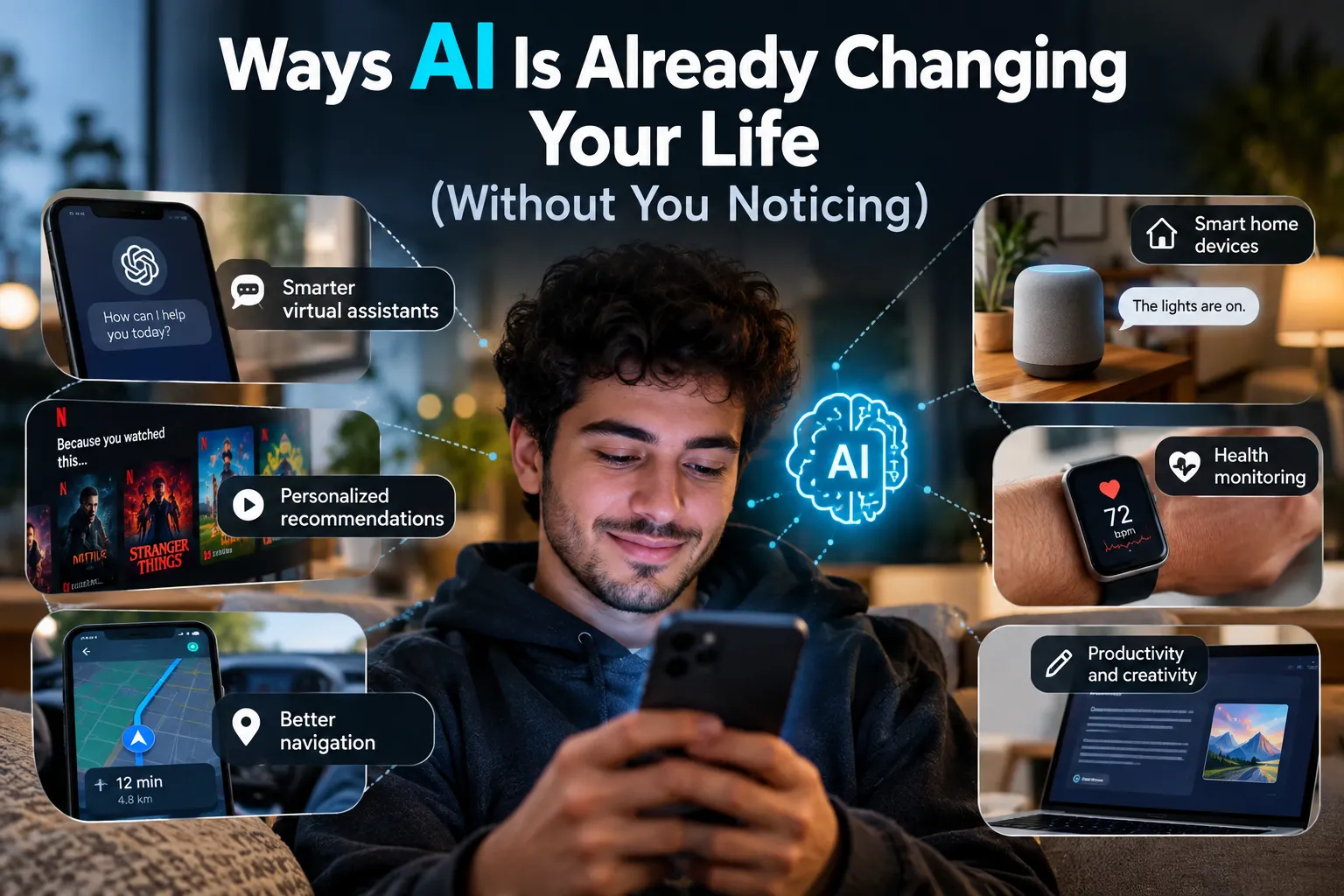
How Artificial Intelligence Is Quietly Rewriting Your Everyday Life (And What Comes Next)
Ten years ago, artificial intelligence sounded like science fiction. Today, it decides which videos you watch, helps doctors spot diseases, and drafts emails before you finish your coffee. AI is no longer a distant promise. It is a daily companion, and most of us barely notice it.
So what exactly is AI, how did it become so powerful so quickly, and where is it taking us? Let's break it down.
What Is Artificial Intelligence, Really?
Artificial intelligence is the ability of a computer system to perform tasks that normally require human intelligence: understanding language, recognizing images, making decisions, and learning from experience.
Most modern AI is built on machine learning, where systems learn patterns from huge amounts of data instead of following rigid, hand-written rules. A subset called deep learning uses layered neural networks, loosely inspired by the human brain, to handle complex tasks like voice recognition and image analysis.
The newest wave, generative AI, goes one step further. Instead of only analyzing information, it creates new content: text, images, music, code, and video.
Why AI Exploded Now
AI research has existed since the 1950s, so why the sudden boom? Three forces collided:
Massive data. Billions of people generate text, photos, and videos every day, giving AI systems rich material to learn from. Powerful hardware. Modern chips, especially GPUs, can process enormous calculations in parallel. Better algorithms. Breakthroughs like the transformer architecture allowed models to understand context far better than before.
Together, these ingredients turned slow experiments into tools millions of people use every day.
AI in Your Daily Routine
You may already use AI dozens of times a day without realizing it:
Smartphones: Face unlock, voice assistants, and camera enhancements all rely on AI. Streaming and social media: Recommendation engines learn your tastes and serve content that keeps you watching. Navigation apps: They predict traffic and suggest faster routes in real time. Online shopping: Personalized suggestions and fraud detection work behind the scenes. Customer service: Chatbots now handle many routine questions instantly.
The technology works best when it feels invisible, and that is exactly why its influence is so easy to underestimate.
Transforming Healthcare
Few fields show AI's potential more clearly than medicine. Algorithms can analyze X-rays, MRIs, and scans, sometimes spotting early warning signs that are easy for the human eye to miss. AI also speeds up drug discovery by predicting how molecules behave, which can shorten research timelines that once took years.
Hospitals use predictive models to identify patients at risk and to optimize scheduling, while wearable devices track heart rhythm and sleep patterns. AI does not replace doctors. It gives them sharper tools and more time to focus on patients.
Reshaping Work and Business
Perhaps the biggest question people ask is: will AI take my job?
The honest answer is nuanced. AI will automate many repetitive tasks, such as data entry, basic reporting, and first-draft writing. But history shows that technology tends to change jobs rather than simply erase them. New roles appear, like prompt engineers, AI trainers, data ethicists, and automation specialists, while existing roles evolve.
Businesses are already using AI to forecast demand, personalize marketing, detect fraud, and write code faster. Workers who learn to use these tools effectively often become more productive and more valuable. In many industries, the real competition is not between humans and AI. It is between people who use AI and people who do not.
Education and Learning
AI is also opening new doors for students. Personalized tutors can explain a concept five different ways until it clicks. Language-learning apps adapt to your level, and accessibility tools turn speech into text, or text into speech, for learners with disabilities.
Of course, this raises concerns about cheating and overreliance. The smartest schools are responding not by banning AI, but by teaching students to use it critically: to question its answers, verify facts, and think independently.
The Challenges We Cannot Ignore
Every powerful technology comes with risks, and AI is no exception.
Bias and fairness. AI learns from human data, which can contain human prejudice. If left unchecked, systems can unfairly influence hiring, lending, or policing decisions.
Privacy. AI thrives on data, which raises serious questions about how personal information is collected, stored, and used.
Misinformation. Generative AI can produce convincing fake images, videos, and articles, making it harder to tell what is real.
Accuracy. AI models can sound confident while being wrong, so human verification remains essential.
Regulation. Governments around the world are still working out how to encourage innovation while protecting people. Clear rules on transparency, accountability, and safety will shape the next decade.
How to Stay Ahead in the Age of AI
You do not need to become a programmer to benefit from this revolution. Here are practical steps anyone can take:
Experiment regularly. Try AI tools for writing, research, planning, and learning to understand their strengths and limits. Build uniquely human skills. Creativity, empathy, critical thinking, and communication are difficult to automate. Stay curious and keep learning. The tools change fast, and adaptability is the most valuable skill of all. Verify before you trust. Always double-check important facts, figures, and sources. Think ethically. Ask how a tool uses data and who might be affected by its decisions. What Does the Future Hold?
Looking ahead, AI will likely become more personal, more multimodal, and more embedded in everything we use. Expect assistants that understand text, voice, and images together, smarter tools in healthcare and climate science, and automation that frees people from tedious work.
Yet the most important question is not what AI can do, but what we choose to do with it. The technology reflects the values of those who build and use it. If guided with care, transparency, and inclusion, AI can help solve some of humanity's biggest challenges, from disease to education gaps to climate change.
Final Thoughts
Artificial intelligence is not a passing trend. It is a foundational shift, comparable to electricity or the internet. It brings extraordinary opportunities alongside real responsibilities. The people who will thrive are not those who fear it or blindly trust it, but those who understand it, question it, and use it wisely.
The AI revolution is already here. The real question is: are you ready to be part of it?

Passkeys Explained: How to Replace Your Passwords Safely
What passkeys are, why they resist phishing, and a step-by-step plan to switch your email, bank and social accounts without getting locked out.
Understanding the Basics of Cybersecurity at Home
Simple, jargon-free steps every household can take to protect accounts, devices and personal data.

15 Best AI Tools for Bloggers in 2026
A practical, honest guide to AI tools for bloggers, with realistic options, safety checks, common mistakes, and a clear starting plan.