Passive Income Ideas That Are Realistic (and the Work Behind Them)
An honest look at passive income: which ideas can pay over time, how much upfront effort each needs, and the myths to ignore.
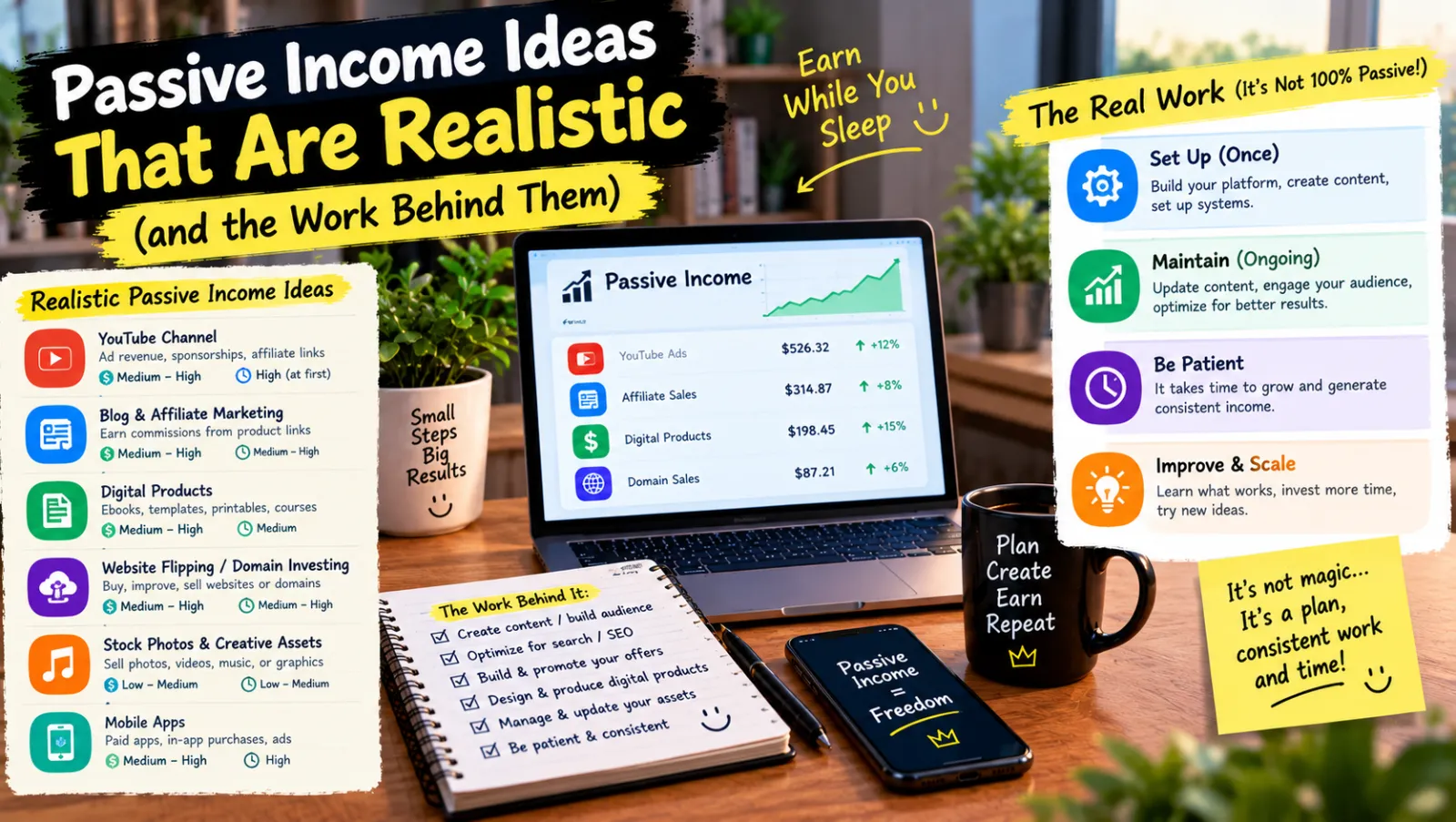
Understanding the Reality of Passive Income
The concept of "passive income" often conjures images of effortless earnings and financial freedom, but the reality is more nuanced. While passive income streams can indeed provide ongoing revenue with minimal ongoing effort, they almost invariably demand significant upfront investment—be it time, capital, or specialized skills. True passivity is a myth; instead, it's about front-loading the work to create an asset or system that generates income over time, requiring only periodic maintenance or optimization. Be wary of any promises of substantial earnings with no initial commitment, as these are frequently deceptive.
The Initial Investment: Time, Money, and Skill
Establishing a genuinely passive income stream requires a clear understanding of its foundational elements. For example, developing a digital product demands expertise in a particular domain and many hours of creation. Investing in dividend-paying assets requires initial capital and financial literacy. Even renting out physical assets like property incurs costs for acquisition, renovation, and ongoing management. This initial phase is crucial and often the most challenging, as it involves crafting a valuable asset or system from the ground up.
Viable Passive Income Avenues to Explore
When evaluating potential passive income streams, it's essential to consider those that have a proven track record and align with your resources and interests. Here are several categories worth investigating:
1. Capital-Based Investments: Dividend-Paying Funds and Real Estate
Investing in dividend-paying exchange-traded funds (ETFs) or individual stocks represents a relatively low-effort approach once the initial research and investment are complete. This method requires a substantial amount of capital to generate meaningful income, and investors must accept the inherent risks of market fluctuations. Diversification across various sectors and geographies can mitigate some of this risk.
- Practical Step: Research reputable index funds or ETFs that focus on dividend-yielding companies. Consult a financial advisor to align your investment strategy with your risk tolerance and financial goals.
- Real Example: An investment in a broad market dividend ETF might yield an average of 2-4% annually, meaning a $100,000 portfolio could generate $2,000-$4,000 per year in dividends, often paid quarterly.
Another capital-intensive option is renting assets. This could range from a spare room in your home, a parking space, vacation property, or specialized equipment. While this can provide consistent income, it involves property management, tenant relations, maintenance, and adherence to legal and insurance requirements.
2. Digital Product Creation and Sales
Creating and selling digital products is a scalable option that leverages your knowledge and skills. This category includes e-books, online courses, software templates, graphic design assets, or photography presets. Once developed, these products can be sold repeatedly with minimal additional effort per sale. However, crafting something genuinely useful, effectively marketing it, and providing ongoing support can take months of dedicated effort.
- Practical Step: Identify a niche where you possess expertise or can solve a common problem. Develop a high-quality product addressing this need, then choose a platform (e.g., Gumroad, Etsy, Teachable) for distribution.
- Real Example: A graphic designer creates a pack of 50 unique social media templates. After spending 100 hours designing and packaging them, they sell the pack for $25. With effective marketing, they might sell 100 packs per month, generating $2,500 monthly, with little ongoing effort beyond customer service.
3. Content Creation with Monetization
Generating content for blogs, YouTube channels, podcasts, or social media platforms can lead to income through advertising revenue, affiliate marketing, or sponsorships. Articles and videos can continue to attract visitors and earn revenue for years once they gain steady traffic and an established audience. Building this audience, however, is a slow process that demands consistency, quality, and strategic promotion.
- Practical Step: Choose a topic you are passionate about and knowledgeable in. Start a blog or YouTube channel, consistently creating valuable content. Incorporate relevant affiliate links for products you genuinely recommend, and explore advertising networks as your audience grows.
4. Licensing and Royalties
For creatives, licensing photos, music, or designs through stock platforms can generate passive income. Platforms like Shutterstock, Getty Images, or Artlist pay royalties each time your content is used. The earnings per use are typically small, so success relies on volume and the enduring quality and relevance of your portfolio.
- Practical Step: Curate your best photography, music, or design work. Understand the submission guidelines for different stock platforms and consistently upload high-quality, in-demand content.
Aligning Ideas with Your Resources
The most effective passive income strategy is one that leverages your existing assets and constraints.
- Time-Rich, Cash-Poor: If you have ample time but limited capital, focus on ventures requiring significant upfront time investment, such as creating digital products, blogging, or building a YouTube channel. These often have low financial barriers to entry but demand consistent effort to build an audience or product library.
- Cash-Rich, Time-Poor: If you have savings but little spare time, diversified investments like dividend ETFs, rental properties (managed by others), or even acquiring an existing small online business might be more suitable. These options typically require less active involvement once established.
- Skill-Rich: If you possess a specialized skill, package it. A coding expert could create software templates, a musician could license original compositions, or a writer could publish an e-book on their niche.
Conducting a Realistic Assessment
Before committing to any passive income idea, it's crucial to perform an honest assessment of its potential return on investment.
Steps for Honest Estimation:
- Estimate Upfront Hours: Calculate the total time required to build the asset or system (e.g., writing an e-book, developing a course, creating a blog with 50 articles).
- Estimate Upfront Costs: Tally all initial financial outlays (e.g., software subscriptions, marketing tools, course fees, website hosting, capital for investments).
- Project Monthly Income: Based on market research and conservative estimates, forecast the expected monthly revenue once the asset is operational.
- Calculate Maintenance Time: Assess the ongoing time commitment for updates, customer support, marketing, or management.
- Compare Against Alternatives:
- What would the estimated upfront hours earn you at your current job or freelance rate?
- Does the projected passive income stream offer a better long-term return for your time and money than simply working more or investing in traditional assets?
This exercise helps to contextualize the "passive" aspect and highlight the substantial initial effort involved. For instance, if an online course takes 300 hours to create and is expected to generate $200 per month, it would take 15 months just to break even on the time investment alone, assuming a $10/hour opportunity cost.
Safeguarding Your Efforts
The allure of easy money makes the passive income space ripe for scams and unrealistic promises. Protect yourself by adhering to these guidelines:
- Beware of Multi-Level Marketing (MLM) Structures: Avoid schemes that require you to recruit others to earn income, as these often prioritize recruitment over genuine product sales and can be unsustainable.
- Question Guaranteed High Returns: If an investment promises unusually high, guaranteed returns with little to no risk, it's almost certainly a fraudulent scheme. Sustainable investments carry inherent risks.
- Resist High-Pressure Tactics: Legitimate opportunities don't demand immediate decisions or pressure you into investing without thorough due diligence.
- Understand Tax Implications: Familiarize yourself with the tax obligations for each income stream in your jurisdiction. Different types of income (e.g., dividends, royalties, business income) may be taxed differently. Consult with a tax professional.
The Power of Focus: Start with One
A common pitfall for aspiring passive income generators is attempting to pursue multiple ideas simultaneously. This often leads to fragmented effort and little progress on any single venture.
Actionable Steps for Focused Execution:
- Select a Single Idea: Choose one passive income idea that aligns best with your resources, interests, and long-term goals.
- Set a Minimum Duration: Commit to working on this single idea consistently for at least six months, or until you achieve a specific milestone (e.g., publishing your first digital product, reaching 1,000 subscribers, making your first sale).
- Resist Diversion: During this period, actively resist the temptation to start new projects or switch to another idea, even if it seems more appealing.
- Evaluate and Iterate: After your initial commitment period, evaluate your progress. What worked? What didn't? How can you improve? Only then consider expanding or adding another stream.
Focusing your energy significantly increases the likelihood of successfully establishing one income stream before you dilute your efforts across several half-finished projects that yield no tangible results.
--- Related Articles:

إنشاء وبيع الكتب الإلكترونية بالذكاء الاصطناعي: دليلك العملي لعام 2026
`تعلم كيفية إنشاء وبيع الكتب الإلكترونية بالذكاء الاصطناعي في 2026 من اختيار الفكرة وكتابة المحتوى حتى التصميم والتسويق لتحقيق دخل سلبي مستدام عبر الإنترنت.

كيف تستلم أرباحك من التدوين والإنترنت في الدول العربية: أفضل البنوك الإلكترونية والحسابات 2026
دليل شامل لسحب واستلام أرباح التدوين والعمل عبر الإنترنت في مصر والدول العربية في 2026. مقارنة بايونير، وايز، بايبال، والحسابات البنكية بالدولار.

A Beginner's Guide to Personal Budgeting That Actually Sticks
A practical, low-stress approach to building a monthly budget you will not abandon after two weeks.