Deep Work for Busy People: A Simple System to Get Important Work Done
How to protect focused time in a distracted world, with a weekly planning method, focus blocks and tools that reduce interruptions.
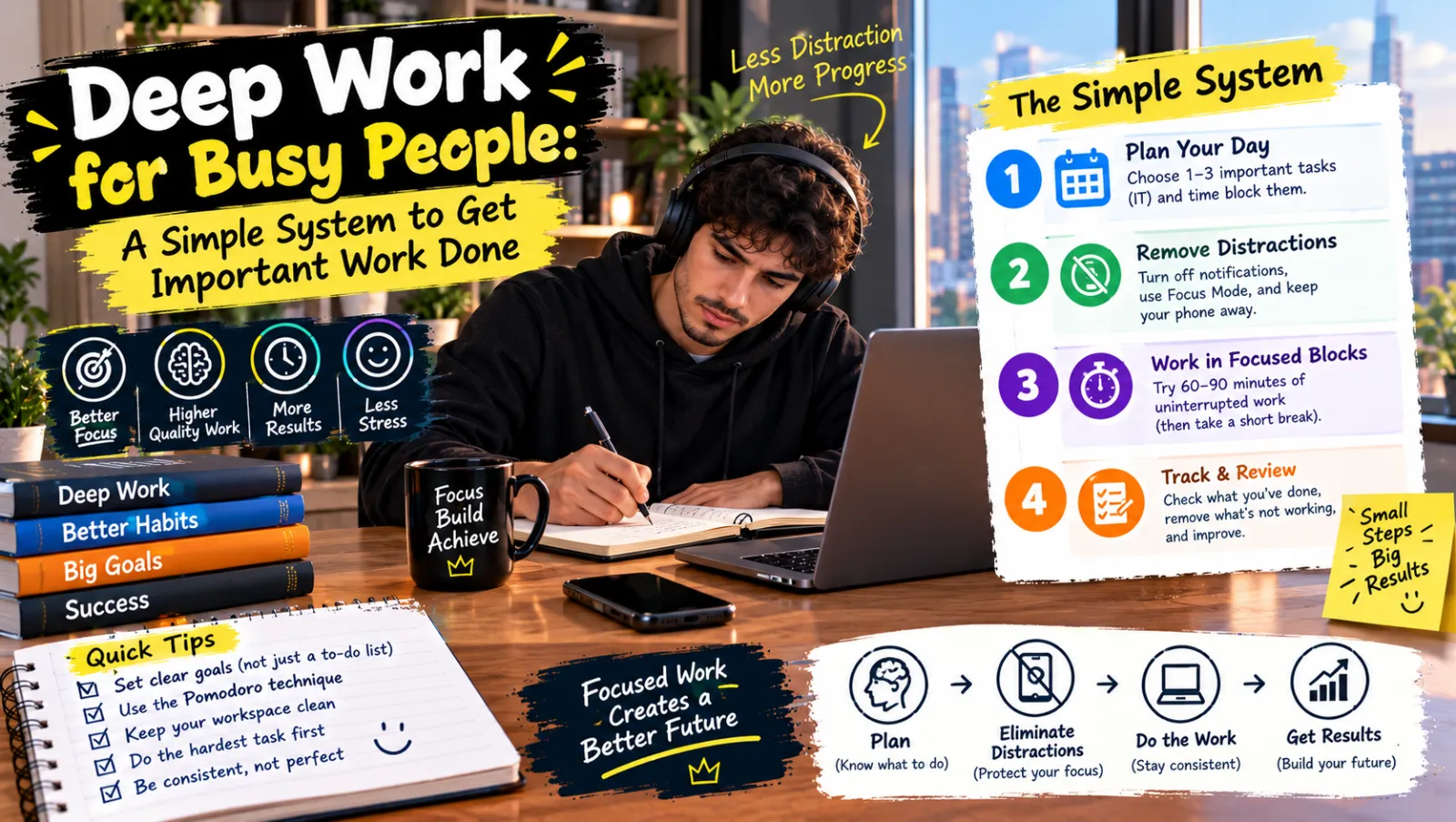
The Escalating Challenge of Sustained Focus
In today's hyper-connected professional landscape, the ability to concentrate deeply on meaningful tasks is increasingly under siege. Our workdays are often fragmented into an endless succession of notifications, impromptu meetings, and immediate message responses. This constant interruption prevents us from engaging in "deep work"—a term coined by Cal Newport that refers to professional activities performed in a state of distraction-free concentration that push our cognitive capabilities to their limit, ultimately creating new value and improving skill. Critical tasks such as strategic planning, complex problem-solving, detailed writing, or acquiring new expertise demand extended, uninterrupted periods of attention. Without deliberate protective measures, the urgent, superficial demands of the day inevitably overshadow and displace the truly important, long-term initiatives. This relentless push-and-pull leaves many professionals feeling busy but unproductive, constantly reacting rather than proactively creating.
Strategically Planning Your Productive Week
Effective deep work doesn't happen by chance; it's a deliberate act of scheduling. Instead of merely planning your day, adopt a weekly planning rhythm.
Identifying Your Core Priorities
At a fixed, consistent time each week, perhaps Friday afternoon or Monday morning, dedicate 30 minutes to identifying your most important outcomes for the upcoming five working days. These are not just tasks; they are the significant deliverables or progress points that will genuinely move the needle for your projects or objectives. Limit yourself to three to five such outcomes to maintain clarity and focus.
- Example 1 (Manager): Develop the Q3 strategic plan draft.
- Example 2 (Developer): Implement the new authentication module.
- Example 3 (Writer): Complete the first draft of Chapter 5.
Pre-Blocking Deep Work Sessions
Once you have identified these core outcomes, immediately block out dedicated time slots in your calendar for each. Treat these blocks as non-negotiable appointments with yourself, just as you would an external meeting. This proactive scheduling prevents other commitments from filling your most valuable time. Choose times when you are naturally most alert and least likely to be interrupted.
- Step 1: Review your upcoming week's calendar for existing commitments.
- Step 2: Identify open slots that align with your peak energy levels.
- Step 3: Assign specific deep work tasks to these blocks, ensuring they directly contribute to your weekly outcomes.
- Step 4: Add a descriptive title to the calendar event, e.g., "Deep Work: Strategic Plan Draft."
Mastering the Art of Focus Blocks
Working in focused bursts is a cornerstone of deep work. Rather than endlessly pushing through, structured focus blocks allow for intense concentration followed by intentional recovery.
Setting Up Your Environment for Undivided Attention
When entering a focus block, aim for 60 to 90 minutes of dedicated work on a single, predetermined task. Before you begin, systematically eliminate potential distractions:
- Close all unnecessary tabs and applications: This includes email clients, instant messaging apps, and social media feeds.
- Silence your phone: Place it out of sight and reach if necessary.
- Prepare your workspace: Gather all necessary materials (documents, notes, coffee) so you don't break concentration later.
- Use a physical notepad: Keep it handy for "stray thoughts." If an unrelated idea, task, or question pops into your mind, quickly jot it down and immediately return to your primary task. This acknowledges the thought without derailing your focus, allowing you to address it later.
This structured approach trains your brain to enter a state of deep concentration more readily, improving both the quality and speed of your output.
Optimizing Your Physical and Social Environment
Your surroundings significantly influence your ability to concentrate. Deliberately shaping your environment can create powerful cues for deep work.
Creating a Dedicated Deep Work Space
Whenever possible, designate a specific location for your focused tasks. This could be a particular desk, a quiet corner of your office, or even a specific café. The consistency helps to create a mental association: "When I'm in this place, I do deep work."
- Minimizing visual clutter: A clean, organized workspace reduces visual distractions.
- Leveraging auditory cues: If ambient noise is an issue, consider noise-canceling headphones. Certain types of instrumental music or white noise can also help some individuals focus.
Communicating Your Unavailability
It's crucial to proactively manage expectations with colleagues, family, or housemates. Inform them when you're entering a deep work block and will be unavailable for interruptions. Simple signals can be highly effective: a "do not disturb" sign on your office door, an away message on your chat application, or a brief conversation before you begin. For remote teams, clearly marking "Focus Time" in your shared calendar can prevent unscheduled calls. These small, consistent actions reinforce your commitment to uninterrupted work and reduce the likelihood of being pulled away from your deep task.
Efficiently Managing Shallow Work
Not all tasks require deep focus. Much of our day is consumed by "shallow work"—logistical, non-cognitively demanding tasks that are often performed while distracted. Examples include responding to emails, administrative duties, or scheduling. While necessary, these should be batched and handled strategically.
Consolidating Communication
Instead of constantly checking and responding to messages, designate specific times for this shallow work. For instance, you might set two dedicated blocks: one in the late morning (e.g., 11:00 AM - 12:00 PM) and another in the late afternoon (e.g., 4:00 PM - 5:00 PM). During these times, you can process your inbox, reply to instant messages, and make quick calls. Most messages can comfortably wait an hour or two without causing significant harm or delay. This approach reduces context-switching costs and protects your valuable deep work blocks. When managing your inbox, consider processing messages using these categories:
- Delete: If it's not relevant.
- Respond Quickly: If it takes less than two minutes.
- Delegate/Forward: If someone else is better suited.
- Schedule for Later: If it requires a longer response or action that can be batched with similar tasks.
The Indispensable Role of Rest and Recovery
Deep work is mentally demanding, making intentional rest and recovery an integral part of the system, not an optional add-on. Neglecting rest inevitably leads to burnout and diminished cognitive performance.
Structured Breaks and Physical Activity
Between your intense focus blocks, take genuine breaks. Step away from your screen and desk.
- Stand up and stretch: Alleviate physical tension.
- Walk around: Even a short walk can clear your head and re-energize you.
- Look away from screens: Practice the 20-20-20 rule (every 20 minutes, look at something 20 feet away for 20 seconds) to reduce eye strain.
- Hydrate and refuel: Ensure you're properly nourished.
Beyond short breaks, prioritize fundamental pillars of well-being:
- Adequate Sleep: Consistent, high-quality sleep is non-negotiable for cognitive function, memory consolidation, and problem-solving abilities. Aim for 7-9 hours per night.
- Regular Exercise: Physical activity directly impacts brain health, mood, and concentration levels. Even moderate exercise can significantly boost your focus.
- Mindfulness or Meditation: Short periods of mindfulness can improve attention span and reduce mental clutter, preparing your brain for deep work.
These elements are not just "nice-to-haves"; they directly affect your capacity for sustained concentration and deep thinking.
Continuous Review and Iterative Adjustment
A deep work system is not static; it requires ongoing refinement to align with your unique working style and evolving demands.
Weekly Reflection for Optimization
At the close of each week, dedicate time to reflect on your deep work efforts. This review helps you understand what worked, what didn't, and how to improve.
- What did you accomplish? List the significant deep work tasks you completed, tying them back to your initial weekly outcomes.
- What interrupted your focus? Identify recurring distractions or unexpected events that derailed your deep work blocks. Was it an urgent request? A poorly communicated meeting?
- Which block times were most effective? Did you find mornings more productive than afternoons? Were 60-minute blocks better than 90-minute ones for certain tasks?
- How did you feel? Assess your energy levels and overall satisfaction with your productivity.
Use these insights to adjust your plan for the following week. Perhaps you need to schedule deep work earlier in the day, communicate your unavailability more clearly, or break down large tasks into smaller, more manageable focus blocks. Over time, this iterative process will help you discover your personal rhythm for deep work, enabling you to build a robust system that protects your most valuable time and ensures you consistently tackle your most important work.

The Quiet Craft of Writing Online in 2026
Why patient, original writing still wins attention in a noisy internet, and how new writers can build a lasting readership.
عادات صغيرة تصنع يومًا أكثر إنتاجية
مجموعة من العادات اليومية البسيطة التي تساعدك على التركيز وإنجاز المهم دون إرهاق.
الإنتاجية في العمل عن بعد: عادات عملية لتنجز أكثر بضغط أقل
كيف تنظم يومك عند العمل من المنزل: الروتين، مساحة العمل، إدارة المشتتات، والفصل بين العمل والحياة.